

What Is Forward Osmosis? FO vs. Reverse Osmosis Explained
Forward osmosis (FO) is an emerging membrane technology that uses natural osmotic pressure — not applied hydraulic pressure — to purify and concentrate water. AMPAC USA explains the science, the differences from RO, and where FO is reshaping water treatment.
Quick Answer: What Is Forward Osmosis?
Forward osmosis (FO) is a membrane-based water treatment process that uses the natural osmotic pressure difference between two solutions to draw water across a semipermeable membrane from a dilute feed solution into a concentrated draw solution — without requiring significant applied hydraulic pressure. The process exploits the same osmotic principles as biological cell membranes, making FO inherently low-energy and highly resistant to membrane fouling compared to pressure-driven processes like reverse osmosis.
Defining Forward Osmosis: The Science Behind FO
To understand forward osmosis, it is essential to first understand the natural phenomenon it exploits. Osmosis is the spontaneous movement of water molecules across a semipermeable membrane from a region of lower solute concentration (higher water chemical potential) to a region of higher solute concentration (lower water chemical potential). This movement continues until osmotic equilibrium is reached or an opposing pressure is applied.
Forward osmosis harnesses this natural driving force deliberately. In an FO system, a highly concentrated solution called the draw solution is placed on one side of the membrane and the contaminated or lower-concentration feed solution on the other. Because the draw solution has a much higher osmotic pressure, water migrates naturally from the feed across the membrane into the draw solution, leaving contaminants behind in the feed and diluting the draw solution.
The diluted draw solution then undergoes a secondary separation step to recover the draw solute and yield the final purified water product. This secondary step — which may use reverse osmosis, distillation, or other methods depending on the draw solute chosen — is where much of the system design complexity lies.
The Role of the Draw Solution
The draw solution is the defining element of any FO system. It must generate sufficient osmotic pressure to draw water through the membrane efficiently, and it must be recoverable and reusable in a cost-effective manner. Common draw solution types include:
- Ammonium bicarbonate (NH4HCO3): Thermally decomposable at low temperatures (~60°C), enabling recovery via gentle heating with minimal energy input. Widely studied in research applications.
- Sodium chloride (NaCl) brines: Simple and inexpensive, but recovery via RO or evaporation adds cost and complexity.
- Magnetic nanoparticle solutions: Recoverable using magnetic fields; under active research for reducing secondary treatment energy.
- Polyelectrolytes and responsive polymers: Can be recovered by temperature or pH stimulus; promising for specialized applications.
- Commercial food-grade solutes (e.g., sucrose, glucose): Used in food and beverage concentration applications where the draw itself becomes the product.
FO–RO Hybrid Pilot Systems
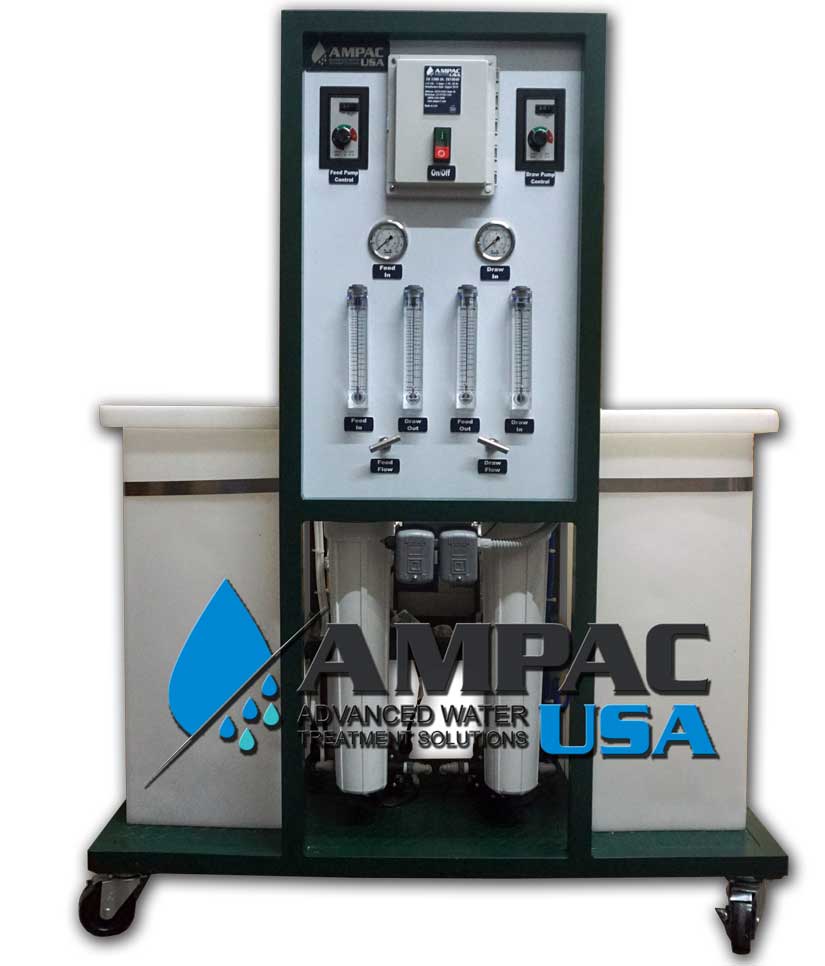
AMPAC USA has evaluated FO–RO hybrid configurations for high-fouling and high-TDS applications. In these systems, FO serves as a low-fouling pre-concentration step before a final RO polishing pass — achieving water recovery rates that standalone RO cannot reach while protecting downstream membranes from fouling.
These configurations are especially relevant for produced water treatment, landfill leachate, and near-zero liquid discharge (ZLD) applications.
How the Forward Osmosis Membrane Works
FO membranes share structural similarities with RO membranes but are engineered with distinct priorities. Because FO operates without significant applied pressure, the membrane does not need the thick, rigid support layer required for pressure-driven processes. Instead, FO membranes are optimized for:
- Minimum internal concentration polarization (ICP): In FO, solutes can accumulate within the membrane support layer, reducing effective osmotic driving force. Thin, highly porous support structures minimize ICP.
- High water permeability (A value): FO membranes must allow rapid water transport through osmotic driving force alone.
- High salt rejection (B value): The membrane must prevent reverse diffusion of draw solute back into the feed stream, which reduces efficiency.
- Chemical robustness: FO membranes must withstand exposure to draw solution chemistry across a wide range of pH, temperature, and concentration conditions.
Current commercial FO membranes are primarily cellulose triacetate (CTA) flat-sheet or thin-film composite (TFC) hollow-fiber designs. TFC hollow-fiber membranes are increasingly favored for industrial FO applications due to their large surface area per module volume and superior water flux characteristics.
A key distinction from RO: because FO is not driven by hydraulic pressure, membrane fouling layers tend to be loose and hydraulically reversible — a significant operational advantage over RO, where fouling compacts under high pressure and requires chemical cleaning.
Forward Osmosis vs. Reverse Osmosis: Head-to-Head Comparison
FO and RO are complementary membrane technologies, not direct substitutes. Understanding their differences is essential for selecting the right approach for a given application:
| Parameter | Forward Osmosis (FO) | Reverse Osmosis (RO) |
|---|---|---|
| Driving Force | Natural osmotic pressure gradient (chemical potential difference) | Applied hydraulic pressure exceeding osmotic pressure |
| Operating Pressure | Very low (<5 PSI hydraulic; osmotic: varies) | 40–1,200 PSI depending on feed water TDS |
| Energy Consumption (membrane stage) | Very low (osmotic process requires minimal pumping) | Moderate to high (3–18 kWh/m³ depending on salinity) |
| Total System Energy (incl. draw recovery) | Comparable or higher when draw recovery energy is included | Lower for single-pass applications |
| Membrane Fouling | Low; fouling is loose and reversible (hydraulically cleanable) | Moderate to high; compacted fouling requires chemical CIP |
| Water Recovery Rate | Potentially very high (>90%) with appropriate draw recovery | 20–85% depending on application and system design |
| Contaminant Rejection | High for most dissolved solids and biologicals | 90–99.99% across dissolved solids, biologicals, chemicals |
| System Complexity | Higher: requires draw solution recovery loop | Lower: single-pass with pre- and post-treatment |
| Capital Cost | Generally higher (emerging technology, draw recovery system) | Lower to moderate; mature, competitive market |
| Technology Maturity | Emerging; commercial pilots and early deployments | Mature; global standard across all scales |
| Best Applications | High-fouling feeds, concentration, pre-treatment, food/beverage | Drinking water, desalination, industrial purification |
Key Takeaway
FO is not a replacement for RO — it is a complementary technology. FO excels where fouling is a critical challenge, high water recovery is required, or where the product is a concentrated liquid (food/beverage) rather than purified water. RO remains the global standard for producing purified water at any scale with proven economics and reliability.
When to Choose FO Over RO
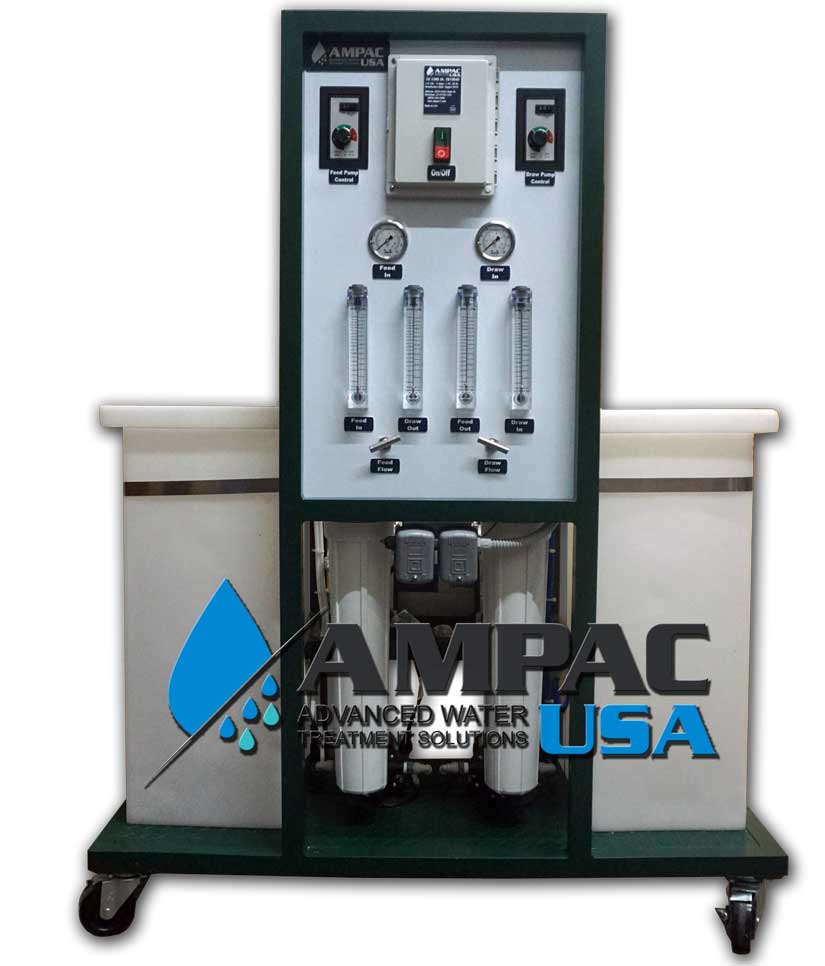
FO is not a replacement for RO — it is a complementary technology. FO excels where fouling is a critical challenge, high water recovery is required, or where the product is a concentrated liquid rather than purified water. RO remains the global standard for producing purified water at any scale with proven economics and reliability.
For most drinking water, process water, and desalination applications, AMPAC USA's proven RO systems deliver superior economics and performance.
Where Is Forward Osmosis Used? Key Applications
Forward osmosis occupies a unique position in the water treatment landscape, offering advantages in specific scenarios where conventional pressure-driven processes face limitations. Current and emerging FO applications include:
Wastewater Reuse
FO's fouling resistance suits high-strength feeds: municipal wastewater, landfill leachate, and oil & gas produced water — achieving very high water recovery where RO would fail.
Desalination Pre-Treatment
Osmotic dilution uses FO to dilute seawater with treated wastewater before SWRO, cutting energy consumption by 20–40%. A promising pathway for coastal water-stressed regions.
Food & Beverage Concentration
FO concentrates juices, dairy, and heat-sensitive liquids at ambient temperature without pressure — preserving aroma compounds, vitamins, and flavors destroyed by thermal evaporation.
Military & Field Operations
Osmotic hydration pouches and compact FO units provide safe drinking water in disaster relief and military field conditions with minimal infrastructure requirements.
Pharmaceutical & Biopharma
FO concentrates temperature-sensitive pharmaceutical solutions, protein formulations, and biologics — the gentle, pressure-free process preserves molecular integrity better than high-pressure methods.
Osmotic Energy (PRO)
Pressure-retarded osmosis uses the osmotic gradient between river water and seawater to generate mechanical energy — a salinity-gradient power source still in pre-commercial development.
Challenges and Current Limitations of Forward Osmosis
Despite its promise, forward osmosis faces significant technical and economic hurdles that have slowed commercial adoption relative to reverse osmosis:
Draw Solution Recovery Energy
The secondary step to recover the draw solute and extract pure water often requires energy comparable to or exceeding that of a conventional RO system, negating the low-energy advantage of the FO membrane stage itself.
Reverse Solute Diffusion
Draw solute molecules diffuse back through the membrane into the feed stream, contaminating it and reducing the osmotic driving force over time. Minimizing reverse diffusion requires highly selective membrane design and draw solute selection.
Internal Concentration Polarization (ICP)
Solute concentration gradients that build within the membrane support layer reduce effective osmotic driving force and water flux, limiting system productivity. Novel thin-support membrane designs are actively addressing this challenge.
Technology and Market Maturity
FO membranes and systems are not yet produced at the economies of scale that make RO so cost-competitive. Limited commercial deployments, fewer equipment suppliers, and nascent operational knowledge bases create higher project risk and cost.
AMPAC USA's Expertise in Advanced Water Technologies
AMPAC USA has been engineering membrane-based water treatment systems in the United States since 1989. While reverse osmosis remains the proven workhorse of our product line — from residential under-sink units to multi-million-gallon-per-day seawater desalination plants — our engineering team tracks and evaluates emerging technologies including forward osmosis, membrane distillation, and electrochemical desalination.
For customers facing water treatment challenges where conventional RO struggles — such as extremely high-TDS brines, high-fouling industrial waste streams, or applications requiring near-zero liquid discharge — AMPAC USA's engineers are available to evaluate whether forward osmosis or hybrid FO-RO configurations offer a practical advantage over standalone RO systems.
In most current applications — including drinking water purification, seawater desalination, commercial food service, and industrial process water — our NSF-certified reverse osmosis systems deliver the best combination of proven performance, operating economics, and technical support. We recommend exploring our comprehensive reverse osmosis guide if you are evaluating RO for your application.
Not Sure Which Technology Is Right for Your Application?
Our water treatment engineers can evaluate your source water, volume requirements, and quality targets to recommend the optimal technology — whether that is a conventional RO system, a hybrid approach, or an emerging membrane technology. Contact AMPAC USA for a free engineering consultation.
Built in the USA Since 1989
Every AMPAC USA system is engineered, assembled, and tested at our facility in Woods Cross, Utah. From standard commercial RO systems to custom-engineered ZLD and FO-hybrid pilot plants, our team delivers membrane water treatment solutions for the most demanding industrial and municipal applications worldwide.
Talk to an EngineerCompare Water Treatment Technologies with AMPAC USA
From proven RO systems to advanced water treatment engineering, AMPAC USA has the expertise to find the right solution for your water challenge.
Call us: (909) 762-8020
Frequently Asked Questions About Forward Osmosis
What is the main difference between forward osmosis and reverse osmosis?
The fundamental difference is the driving force. Reverse osmosis uses applied hydraulic pressure to force water through a membrane against the natural osmotic gradient, directly producing purified water as the permeate. Forward osmosis uses the natural osmotic pressure gradient between a concentrated draw solution and a dilute feed solution to draw water across the membrane without significant applied pressure. FO produces a diluted draw solution rather than directly purified water — a subsequent draw recovery step is needed to extract the final pure water product. RO is a mature, proven technology with lower system complexity; FO offers advantages in fouling resistance and potentially higher water recovery for certain challenging feed streams.
Is forward osmosis more energy-efficient than reverse osmosis?
The FO membrane stage itself requires very little hydraulic energy, since the process is driven by natural osmotic pressure rather than pumps pushing against high pressure. However, the overall system energy footprint of FO depends critically on the draw solution recovery step. If the draw solute is recovered by RO or thermal processes, the total system energy is often comparable to — and in some cases exceeds — that of a conventional single-pass RO system. FO's energy advantage is most pronounced in hybrid systems (such as osmotic dilution before SWRO) or when the draw solution can be recovered by low-grade waste heat, making it genuinely more energy-efficient end-to-end.
What is a draw solution in forward osmosis?
In forward osmosis, the draw solution is a highly concentrated solution placed on one side of the FO membrane that generates the osmotic pressure driving force for water transport. The draw solution must have a higher osmotic pressure than the feed water being treated so that water molecules migrate naturally from the feed, through the membrane, and into the draw. Common draw solutions include ammonium bicarbonate salts (recoverable by mild heating), sodium chloride brines, and food-grade solutes like sucrose for food processing applications. The ideal draw solution is highly soluble, generates high osmotic pressure, can be recovered and reused efficiently, and is non-toxic and non-reactive with the membrane material.
Why does forward osmosis have less membrane fouling than reverse osmosis?
In reverse osmosis, high applied hydraulic pressure compacts fouling layers (biofilms, scale, colloidal deposits) tightly against the membrane surface, making them difficult to remove without chemical cleaning. In forward osmosis, there is no significant applied pressure to compact these layers, so fouling deposits remain loose, hydrated, and physically reversible — simple hydraulic flushing or osmotic backwashing can restore flux without harsh chemicals. This makes FO particularly attractive for high-fouling feed waters such as municipal wastewater, produced water, and food processing streams where RO membranes would require frequent and costly chemical cleaning cycles.
Is forward osmosis commercially available, and does AMPAC USA offer FO systems?
Forward osmosis is available commercially from a limited number of specialized manufacturers, primarily for niche applications in food and beverage concentration, wastewater treatment, and military hydration products. The technology has not yet achieved the mainstream scale and cost-competitiveness of reverse osmosis. AMPAC USA's current product line centers on proven, NSF-certified commercial RO systems and residential RO systems, which deliver the best combination of performance, economics, and reliability for the vast majority of water treatment applications. If you have a specific application where FO may be advantageous, our engineering team is available to discuss your requirements and evaluate all relevant technology options. Contact us for a free consultation.
Speak with a Water Treatment Engineer
AMPAC USA — Made in the USA • NSF Certified • 35+ Years of Membrane Water Treatment Expertise